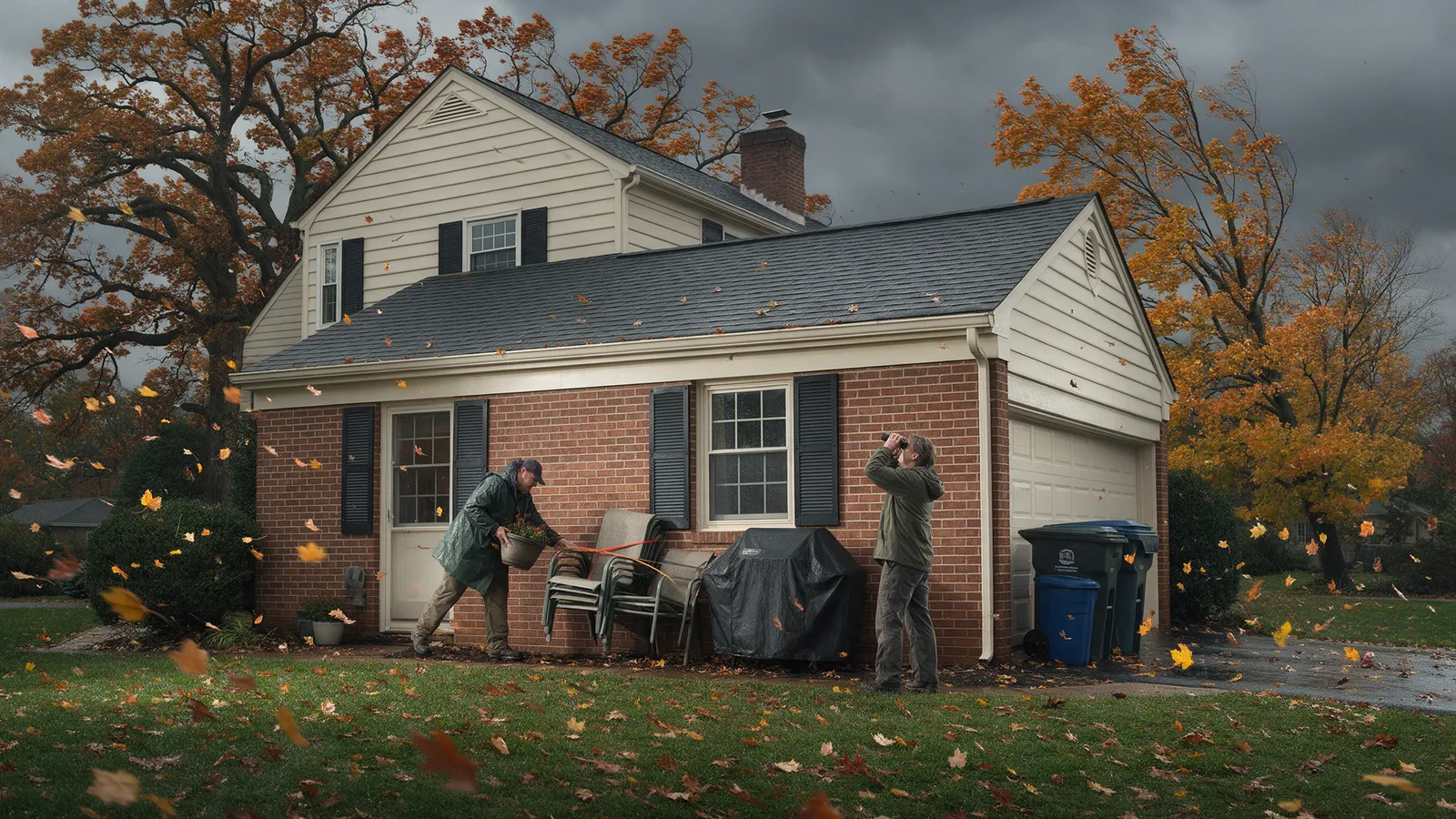
A nor’easter is a coastal storm that spins up along the East Coast and pulls wind in from the northeast, usually between September and April. In the DMV it means a day or two of sideways rain or wet snow, gusts strong enough to bring down oak limbs, and the tidal flooding that fills Old Town Alexandria and the Southwest Waterfront. Most of the damage we see afterward wasn’t caused by the storm alone. It was caused by something loose that the storm found.
This checklist is about removing those loose things. Everything here is ground-level, indoor, or one-story-ladder work. Nothing on it requires getting on a roof.
What you’ll need
- Binoculars (for looking at your roof from the yard)
- A work glove and a trowel or gutter scoop
- A one-story extension ladder with a stabilizer, used only for first-floor gutters and only on dry, level ground
- Rope or ratchet straps for furniture and grills
- A phone with your utility’s outage app installed (Pepco, Dominion, BGE, or your co-op)
- Flashlights, batteries, and a battery carbon monoxide alarm
- Your insurance declarations page and a phone camera
Step 1: Walk the yard and look up
Start at the curb and walk the whole perimeter of the house with binoculars. You’re looking for anything that can become a projectile or a leak path.
On the roof, from the ground: lifted or curled shingle edges, a shingle tab that’s flapping, exposed nail heads along ridges, and flashing at the chimney or wall that has pulled away. Any of those is a wind-entry point. A nor’easter’s sustained pressure will peel back a shingle that a summer thunderstorm only lifted.
In the trees: dead limbs hanging over the roof, the driveway, or the power drop to your house. Mature oaks and maples in Chevy Chase, Takoma Park, and Arlington drop the largest limbs of any yard tree in the region, and a dead limb over a service line is a job for the utility or a licensed arborist, not a pole saw.
If you spot a loose shingle, flashing gap, or a dead limb over a line, write it down. The decision on each is in the table below.
Step 2: Clear the water paths
A nor’easter can dump two or three inches of rain in a day onto a roof that’s already shedding leaves. If that water can’t get off the roof and away from the house, it finds the basement.
Scoop first-floor gutters and flush the downspouts with a hose. Watch where the water exits. A downspout that dumps at the foundation needs an extension of at least a few feet, pointed downhill. We covered the grading side of this in our downspout and grading guide.
Clear the area drains and window wells. Leaf-blocked area drains at the bottom of basement stairwells are the single most common reason DMV rowhouse basements take on water during a coastal storm. Pull the grate, clear the bowl, and confirm it drains.
Check the sump pump. Pour a bucket of water into the pit and confirm the pump kicks on and the discharge line runs clear outside. If you have a battery backup, test it now. If you don’t, know that the pump stops the moment the power does, and this is a storm that takes power down.
Second-story gutters stay on the list for a pro. The 4-to-1 ladder rule and a stabilizer make one-story work reasonable. Nothing makes two-story ladder work in a rising wind reasonable.
Step 3: Secure or stow everything that isn’t bolted down
The things that hit windows and siding in a nor’easter are almost always the homeowner’s own things. Go through the yard and the deck with one rule: if you can lift it, the wind can.
| Item | What to do | Why |
|---|---|---|
| Patio chairs, cushions, umbrellas | Inside, or stacked and strapped in a corner | Umbrellas become spears; chairs skid into siding and glass |
| Grill | Close the lid, shut the propane valve, strap it to a post or roll it against the house on the lee side | A tipped grill can snap the gas line |
| Trash and recycling bins | Garage, shed, or behind a fence | Bins are the most common thing we find through a neighbor’s window |
| Potted plants and planters | Ground level, against a wall, grouped tightly | Tall pots blow over and shatter |
| Trampoline | Anchor kit staked at every leg, or disassemble | Trampolines are sails; they travel whole yards |
| Hanging baskets, wind chimes, flags | Take down | Light, but they swing into windows and strip paint |
| Hoses, tools, kids’ toys | Shed or garage | Clutter clogs drains when it blows into them |
| Deck boards, loose railing | Screw down what’s loose, flag what you can’t | Loose decking lifts and takes the railing with it |
Then check what’s attached. Tug on shutters, satellite dishes mounted at eye level, and the downspout straps. A downspout that rattles will be in the yard by morning.
Step 4: Button up the doors and windows
Close and latch every window, including the storm windows if you have them. Lock them; the locking action pulls the sashes tight against the weatherstripping and cuts wind noise and water intrusion.
Look at the exterior caulk around window trim. If the bead has pulled away, you won’t fix it properly in the rain, but a temporary bead of exterior caulk on a dry afternoon before the storm will keep driving rain out of the wall cavity. Our recaulking guide covers the temperature rule that matters in fall.
Inside, pull blinds and curtains on windows facing the wind, usually the north and east sides in a nor’easter. If a branch does come through, the fabric catches the glass.
Garage doors deserve a note. A wide garage door is the largest, weakest opening on most houses. Make sure it’s fully closed and latched, and park the car with the nose toward the door if the panel is older or flexes in the wind. That’s not an engineering fix, but it keeps a flexing panel from bowing inward.
Don’t tape glass. It does nothing to prevent breakage and can create larger shards.
Step 5: Prepare for the outage, not just the storm
Nor’easters take power out across the DMV because wet snow and saturated ground bring trees onto lines. Plan for a day or more without it.
Fill water. The common guideline from FEMA and Ready.gov is one gallon of water per person per day for at least three days, for drinking and sanitation. If you have a well, your pump stops with the power, so fill the bathtub too.
Charge everything and locate the flashlights. Candles and old oil lamps are how house fires start during outages. Battery lanterns are cheap.
Set up the generator correctly. Run a portable generator outdoors only, at least 20 feet from the house, with the exhaust pointed away from doors, windows, and vents. Never in a garage, even with the door open. Plug appliances into the generator with outdoor-rated cords, or into a transfer switch an electrician installed. Never backfeed the house through a dryer outlet. That energizes the lines outside and can kill the lineman restoring your power.
Install a battery carbon monoxide alarm on every floor and outside sleeping areas if you don’t already have them.
Save the utility numbers now. Report outages through the utility’s app or outage line, not 911. Call 911 for a downed line that’s touching a car, a person, or is sparking. Treat every downed wire as live and stay well back; Dominion’s guidance is at least 30 feet, and the same distance is sensible everywhere.
Step 6: Document before, so you can claim after
Walk the house with your phone and photograph every exterior elevation, the roof from the ground, the deck, the fence, and the yard. Timestamped “before” photos are the strongest thing you can hand an adjuster. Then open your insurance declarations page and read three things:
| What to find | Why it matters |
|---|---|
| Wind or “named storm” deductible | Often a percentage of the home’s insured value, not the flat deductible you remember |
| Flood exclusion | Standard policies exclude surface water and surge; a separate flood policy is required and new NFIP policies typically take 30 days to start |
| Claims phone number | You want it saved before the lines are busy |
We walked through the whole claims process in our storm damage and insurance page, including how to handle a roofer who shows up uninvited after the storm.
The two-day timeline
| When | Do |
|---|---|
| 48 hours out | Yard walk with binoculars, gutter and drain clearing, caulk touch-ups, book a pro for anything on the roof or in a tree |
| 24 hours out | Stow or strap outdoor items, test sump pump, fill water, charge devices, stage the generator outside |
| Night before | Close and lock windows, pull blinds on the windward side, take “before” photos, park the car away from large trees |
| During | Stay inside, stay off ladders, stay away from windows during gusts |
| After | Photograph damage before moving anything, check the attic for stains, call the utility about any downed line |
When to stop and call a professional
Some things on the list can’t be made safe to do yourself before a storm, and the storm doesn’t care.
- Anything on the roof. A lifted shingle, a flashing gap, or a loose ridge cap needs a roofer with fall protection, not a homeowner on a ladder. A roofer can often make a pre-storm emergency seal in an hour.
- Dead limbs over the house or over your service drop. A licensed, insured arborist. If the limb is over a utility line, call the utility first. They may trim it for free.
- Second-story gutters, windows, or shutters. Stay off tall ladders, and never set any ladder within 10 feet of a power line.
- Garage door that bows or won’t latch. A garage door company can add bracing or a new latch.
- Any electrical work for a generator. A transfer switch is a licensed electrician’s job in every DMV jurisdiction, and it’s the only safe way to power a furnace or well pump.
- Structural concerns. A sagging roofline, bowed wall, or cracked foundation is a storm’s favorite target. Get an engineer or contractor out before the wind does.
If the yard walk turns up lifted shingles or pulled flashing, our roofing team can seal it before the storm arrives. Loose siding panels and bowed trim are a siding call, and rattling sashes or failed storm windows fall under windows. For what to do when the storm leaves damage behind, start with our storm damage and insurance page and the fall gutter and roof check, and find your neighborhood on our areas we serve page across DC, Maryland, and Northern Virginia.
Common questions
How much wind does a nor'easter actually bring to the DC area?
It varies a lot. Inland DMV neighborhoods often see gusts in the 40 to 50 mph range during a strong nor'easter, while the Chesapeake shore and the lower Potomac can get stronger. The National Weather Service issues a Wind Advisory for sustained winds of 31 to 39 mph or gusts of 46 to 57 mph, and a High Wind Warning for sustained winds of 40 mph or more or gusts of 58 mph or more. Treat either alert as your cue to finish this checklist.
Will my homeowners insurance cover nor'easter damage?
Most standard homeowners policies cover wind damage and the rain that gets in through a wind-made opening, though some carry a separate wind deductible that is a percentage of the home's insured value. Flooding from surface water or surge is excluded and needs a separate flood policy, and National Flood Insurance Program policies generally have a 30-day waiting period, so you can't buy one the week of a storm. Check your declarations page now, not after.
Should I tape my windows before a nor'easter?
No. Tape doesn't stop glass from breaking, and it can create larger, more dangerous shards when it does. Taping is widely discouraged by emergency management agencies. If a window is at real risk, close storm windows if you have them, close blinds and curtains, and keep people away from the glass. Plywood or rated storm panels are a pro job on anything above the first floor.
Is it safe to run a generator in my garage with the door open?
No. Carbon monoxide builds up even with the door open. The CDC, CPSC, and FEMA all say to run a portable generator outdoors only, at least 20 feet from the house with the exhaust pointed away from doors, windows, and vents. Install battery carbon monoxide alarms on every floor and outside sleeping areas before storm season.
A note on safety
This guide is general information for homeowners, not a substitute for an on-site assessment. Anything that puts you on a roof, above a single story, or near power lines is work for an insured professional with fall protection.