You’ll often hear “you don’t need a permit for a roof in Virginia.” For a lot of Northern Virginia homes that’s close to right, but it leaves out a lot. The exemption removes the paperwork, not the rules. And a few common situations (historic districts, flood zones, rotted decking) can bring the permit requirement back.
This guide shows you how to work out, in about half an hour, whether your re-roof is exempt and what you should still check before work starts.
What you’ll need
- Your property address and parcel or tax map number (it’s on your tax bill)
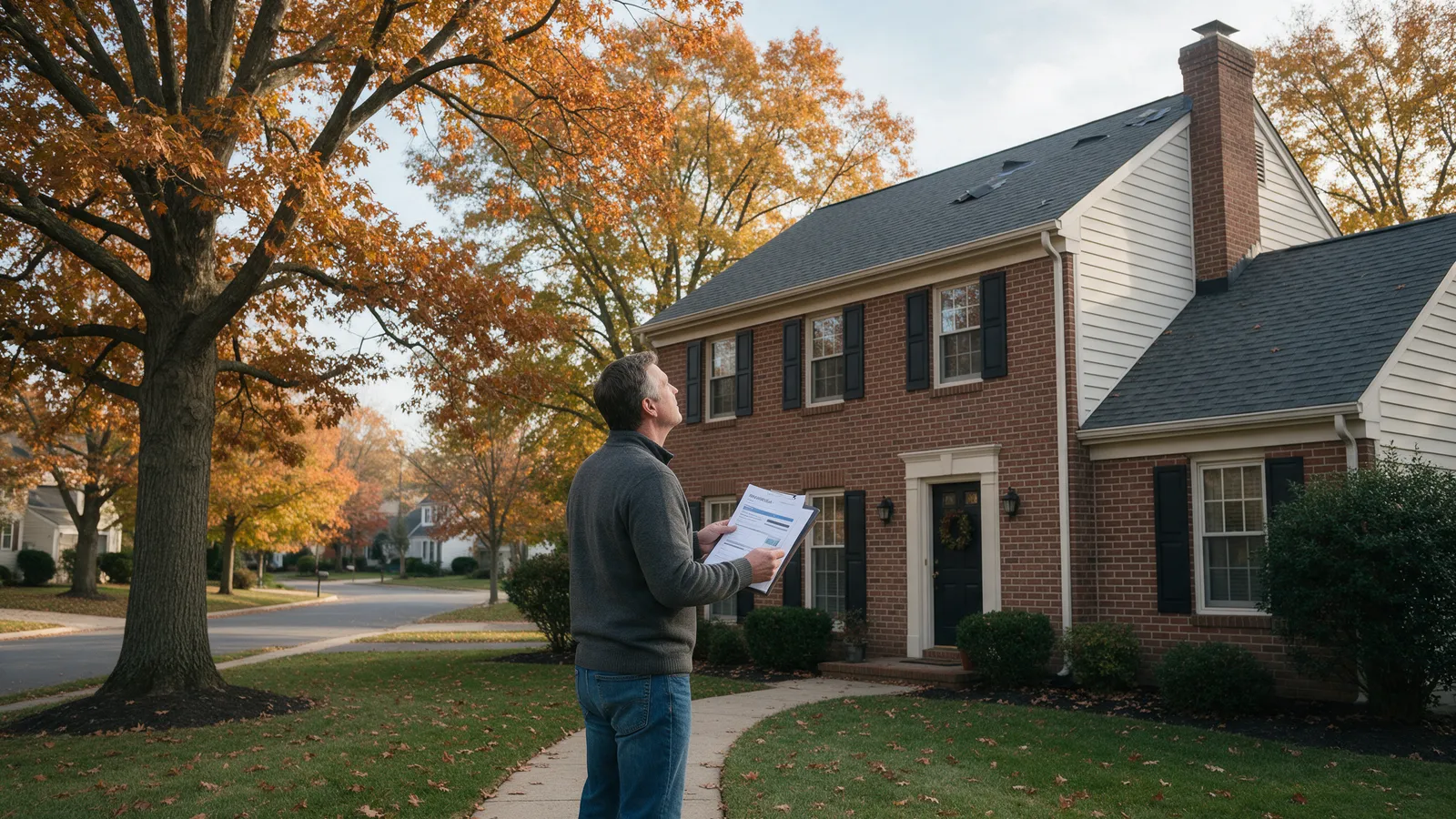
- The roofer’s written proposal, including how much decking they expect to replace
- Your HOA documents, if you have an HOA
- A phone, for one call to your county or city building office
What the exemption actually says
Virginia’s statewide building code (the Uniform Statewide Building Code, or USBC) has a list of work that doesn’t need a permit application or inspection. Under “ordinary repairs,” that list includes:
- Replacing an unlimited amount of roof covering or siding on Group R-3, R-4, or R-5 buildings, as long as the building isn’t in an area where the nominal design wind speed is above 100 mph. Group R-5 is where most detached houses, duplexes, and townhouses fall.
- Replacing 100 square feet or less of roof covering on any building, in any wind zone.
- Replacing 256 square feet or less of roof decking on R-3, R-4, or R-5 buildings, unless that decking originally had to be fire-retardant-treated or protected to form a fire-rated wall termination.
The same section adds two important points. First, the exemption “shall not be construed to exempt such activities from other applicable requirements of this code.” Second, a building official may still require a permit for replacement roofing, siding, or windows in a locally designated historic district, and for any exempted work in a special flood hazard area.
Code text gets amended and renumbered between editions. Treat this as a guide to the questions you should ask, not as legal advice, and confirm with your locality.
Step 1: Confirm what kind of building you have
Make sure your house is in a residential group the exemption covers. A detached single-family house, a duplex, or a townhouse built under the residential code is usually R-5. Condos, apartment buildings, and mixed-use buildings with shops downstairs are usually different groups. In those cases the unlimited-roofing exemption may not apply, and only the 100-square-foot allowance does.
If you own a townhouse in an association, the association may own or control the roof. Read your documents before you hire anyone.
Step 2: Check whether you’re in a local historic district
Look up your parcel on your locality’s historic-district map, or call the planning office. This is where Northern Virginia homeowners get caught most often. Several jurisdictions have locally designated districts. In Alexandria’s Old and Historic District, for example, roofing work typically needs Board of Architectural Review approval before a building permit is issued. The city’s guidelines have long pushed for roof materials that suit the building’s historic period.
In a historic district, plan on these extra steps:
- Design review comes first. Staff can often approve a like-for-like replacement administratively. Changing materials, like slate to asphalt, can need a board hearing.
- Material choices may be limited, mostly on roofs that can be seen from the street.
- Allow extra lead time. Ask the planning office how long review usually takes before you schedule your roofer.
Step 3: Check your flood zone
Look up your address on FEMA’s Flood Map Service Center (msc.fema.gov). If the house is in a special flood hazard area, the building official can require a permit even for work that’s normally exempt. Low-lying parts of the region near the Potomac and its tributaries are worth checking. If you’re unsure how to read the map, the county floodplain office can tell you.
Step 4: Read the proposal for decking and layer count
The scope matters as much as the address. Two items in a roofing proposal can change the answer:
- Decking replacement. The exemption covers 256 square feet or less of decking. Older ramblers and colonials can have more soft sheathing than anyone expects. Ask your roofer what happens if they find more rot once the old roof is off, and who pulls the permit if they do.
- Layers. Exempt work still has to meet code. The model residential code limits recovering (putting new shingles over old ones), and it doesn’t allow a recover over a roof that already has two layers. If the proposal says “overlay,” ask how many layers are already there.
Our roof repair vs. replacement framework and guide on finding leaks from the attic can help you judge the decking from inside before you get bids.
Step 5: Use this table to sort your situation
| Your situation | Permit likely? | What to do |
|---|---|---|
| Detached house or townhouse, standard asphalt re-roof, minimal decking | Usually exempt | Confirm with the building office; keep records |
| Small patch of 100 sq ft or less, any building | Usually exempt | Still use a licensed roofer for paid work |
| Decking replacement over 256 sq ft | Likely required | Get the roofer to confirm who pulls it |
| House in a locally designated historic district | May be required, plus design review | Call planning before choosing materials |
| House in a special flood hazard area | May be required | Ask the building official |
| Condo, apartment, or mixed-use building | Often required | Talk to the association and building office |
| Structural changes: new skylight openings, raised roofline, added dormer | Required | This is construction, not a re-roof |
Step 6: Verify the roofer’s license
Look up the contractor on Virginia’s DPOR license lookup before you sign. Virginia generally requires a state contractor license for jobs valued above $1,000. Class C covers single jobs up to $10,000, Class B covers jobs up to $120,000, and Class A covers anything larger. Most full re-roofs go past the Class C limit, so check that the license class fits your contract amount and that the license is active.
Skipping the permit doesn’t mean skipping the license. With no inspection, a licensed and insured contractor is your main protection.
Step 7: Make your own paper trail
No permit means no inspection record, so create one yourself. Ask for and keep:
- The signed contract, which should name the shingle product, underlayment, ice barrier (if any), flashing, and ventilation work
- Photos of the bare deck after tear-off, with any replaced sheets marked
- The manufacturer’s warranty registration, if the manufacturer offers one
- The final invoice and the contractor’s license number
These help with resale disclosures, warranty claims, and insurance claims later. Our guide on photographing your exterior for insurance covers how to keep the photos useful.
Step 8: Make one confirming phone call
Call your county or city building office and describe the job in one sentence. For example: “Tear-off and re-shingle on a detached single-family house, about 200 square feet of decking, not in a historic district.” Ask whether a permit is required and whether they will issue one voluntarily if you want it. Arlington, Fairfax, Loudoun, Prince William, Alexandria, and the independent cities each have their own building official. Write down the date and the name of the person you spoke with.
When to stop and call a professional
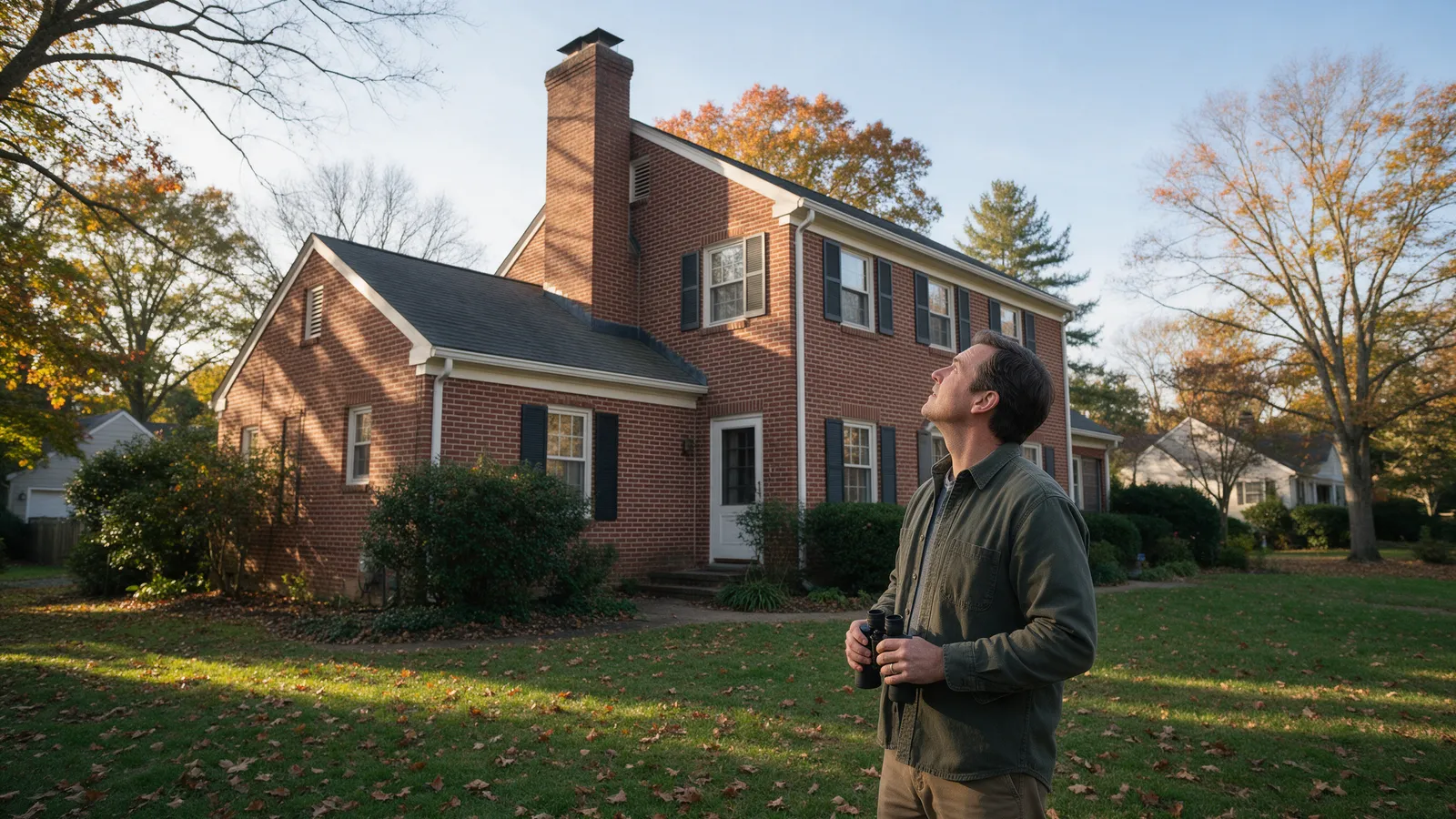
This post is about paperwork. The roof itself is a job for an insured, licensed professional. Don’t walk on your roof to measure it, check layers, or inspect decking. Use binoculars from the ground and a flashlight in the attic, and let the roofer handle anything on the roof surface. Call a pro right away if:
- You see a sagging ridge or a wavy slope, which can mean structural problems
- The attic shows wide water staining, dark or soft sheathing, or daylight through the boards
- The job includes skylights, chimney work, or any change to the roof’s framing
- You’re in a historic district and need help preparing a design-review submission
Next steps
If your roof is due, start with our roofing services page or check whether we serve your neighborhood on the service areas page. If a storm caused the damage, see our storm damage guide first, because insurance documentation should happen before any tear-off. To compare materials before you get bids, read asphalt vs. metal vs. slate roof lifespans. Questions? Call DMV Exterior at 202-798-7663.
Common questions
Do I need a permit to replace my roof in Virginia?
Often not, for a typical house. The Virginia Uniform Statewide Building Code lists replacing roof covering on one- and two-family homes and townhouses as an ordinary repair that doesn't need a permit, as long as the house isn't in an area with a nominal design wind speed above 100 mph. A building official can still require a permit in a locally designated historic district or a special flood hazard area, and bigger decking replacements fall outside the exemption.
If no permit is required, does the roof still have to meet code?
Yes. The state code says plainly that the exemption doesn't excuse the work from the code's other requirements. The new roof still has to be installed the way the building code and the manufacturer's instructions require. What you skip is the permit application and the inspection.
Does my roofer need a license in Virginia?
For most re-roofs, yes. Virginia generally requires a state contractor license from DPOR for jobs valued above $1,000, and the license class depends on the job's size. You can look up any contractor's license on the DPOR website before you sign.
Can I get a permit even if my re-roof is exempt?
Ask your local building office. Some homeowners want an inspection record for resale or insurance. Whether the office will issue a voluntary permit varies, so call before you assume either way.
A note on safety
This guide is general information for homeowners, not a substitute for an on-site assessment. Anything that puts you on a roof, above a single story, or near power lines is work for an insured professional with fall protection.