If you have ever stood under an eave during a July thunderstorm and watched water pour over a gutter you cleaned last month, you already know that gutter choice is not just about looks. Two decisions matter most: seamless or sectional, and 5-inch or 6-inch. Here is how to think through both for DC, Maryland and Northern Virginia houses, and how to gather the facts from the ground before you ask anyone for a quote.
What you’ll need
- A tape measure and a notepad (or phone)
- Binoculars for looking at corners and seams from the ground
- A garden hose and a helper for a water test
- A camera to photograph trouble spots
- A one-story ladder only if you are comfortable with it, set at the 4-to-1 rule (one foot out for every four feet of height) with a stabilizer. Skip it if you are unsure.
Step 1: Understand the real difference between seamless and sectional
Sectional gutters come in pre-cut lengths, usually around 10 feet, that are joined with connectors and sealant. Every joint is a place where the sealant can dry out, crack and start dripping. They are commonly sold at home centers and are a sensible choice for a shed, a small porch roof or a quick repair.
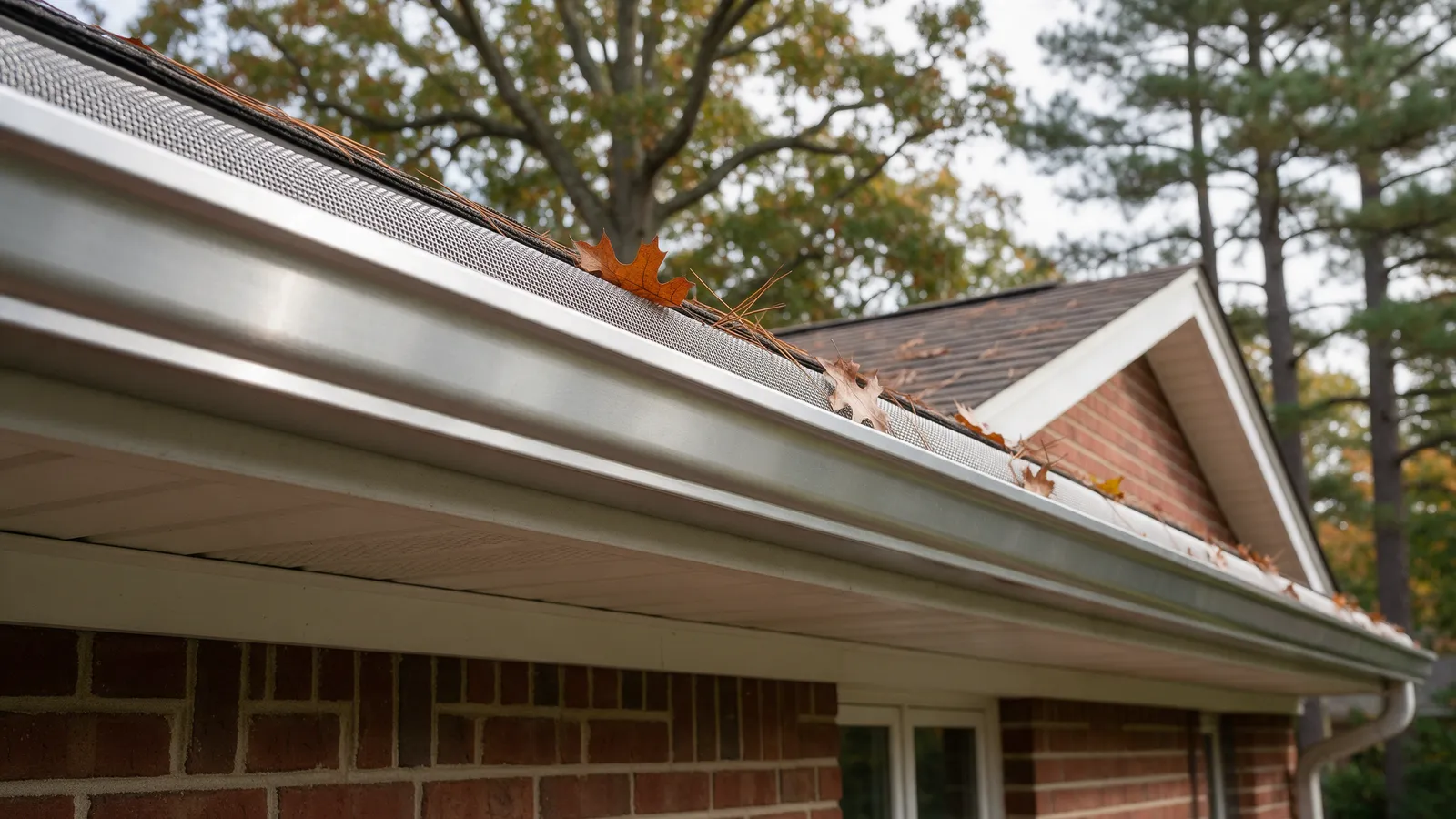
Seamless gutters are formed from a roll of coil metal, usually on site, so a long run is a single piece. Joints exist only at corners, end caps and downspout outlets. Fewer joints means fewer places to leak, but those remaining joints still need good sealing. A sloppy corner on a seamless system will leak just like a sectional one.
| Feature | Sectional | Seamless |
|---|---|---|
| Joints along a straight run | Many | None |
| Typical source | Home center, DIY | Installer forms on site |
| Best fit | Sheds, small runs, repairs | Whole-house runs |
| Weak points | Every connector | Corners, end caps, outlets |
| Long-term upkeep | Reseal joints as they age | Reseal corners and outlets |
Step 2: Look at your joints from the ground
Walk the house with binoculars. Look for the telltale streaks: vertical stains on the siding or fascia below a seam, rust-colored drip lines, or a white mineral trail under a connector.
Then check:
- Sagging between hangers. A dip holds water and stresses the joints.
- Gaps at corners. Daylight or a visible crack is a sign the sealant has failed.
- Peeling paint or soft wood on the fascia behind the gutter, which means water has been getting behind it.
If you see the same problem at several seams on a sectional system, the system itself is the issue, not one bad joint.
Step 3: Run a hose test on a one-story section
On a calm day, have a helper run a hose into the upper end of a gutter while you watch from below. Watch every joint and the outlet. A drip at a seam shows up within a minute or two.
This test also shows you whether water actually moves to the downspout. Water pooling in the middle means a pitch problem. A common guideline is a slight slope toward the downspout, often described as around 1/16 to 1/4 inch per 10 feet depending on the source, but follow the manufacturer’s guidance for your product.
Step 4: Measure how much roof each gutter drains
Gutter size is really about how much roof sends water into one run. Rough numbers:
- Measure the length and the slope-length of each roof plane that drains into a gutter section. Multiply to get square feet.
- Note the pitch. A steeper roof sheds water faster and is often given a higher adjustment factor in sizing charts.
- Count the valleys. A valley that gathers two roof planes and dumps at one corner sends far more water to one spot than the plane’s size suggests.
Sources commonly offer a rough rule: a roof plane of about 600 to 800 square feet may be fine with 5-inch gutters, while 1,000 square feet or more is a case for 6-inch. Treat that as a starting point, not a design. Proper sizing uses local rainfall intensity and pitch, and installers and manufacturers publish charts for it.
Step 5: Compare 5-inch and 6-inch honestly
The most common residential sizes are 5-inch and 6-inch. A 6-inch profile carries up to roughly 40% more than a 5-inch, according to installer sources. That is a meaningful cushion, not a miracle.
| Situation | 5-inch is usually fine | Consider 6-inch |
|---|---|---|
| Small rowhouse or rambler roof | Yes | Rarely needed |
| Large colonial with long, steep planes | Maybe | Often |
| Valleys dumping into one corner | No | Yes, plus extra downspouts |
| Heavy oak or maple canopy | Depends on guards and upkeep | Helps with debris and volume |
| Past overflow in summer storms | Check downspouts first | Yes, if cleaning does not fix it |
Our DMV storms are the reason this matters. Short, intense summer downpours and nor’easters can outpace a small gutter even when it is spotless. If your gutters overflow only when they are clogged, you need cleaning. If they overflow when clean, you need capacity.
Step 6: Don’t forget the downspouts
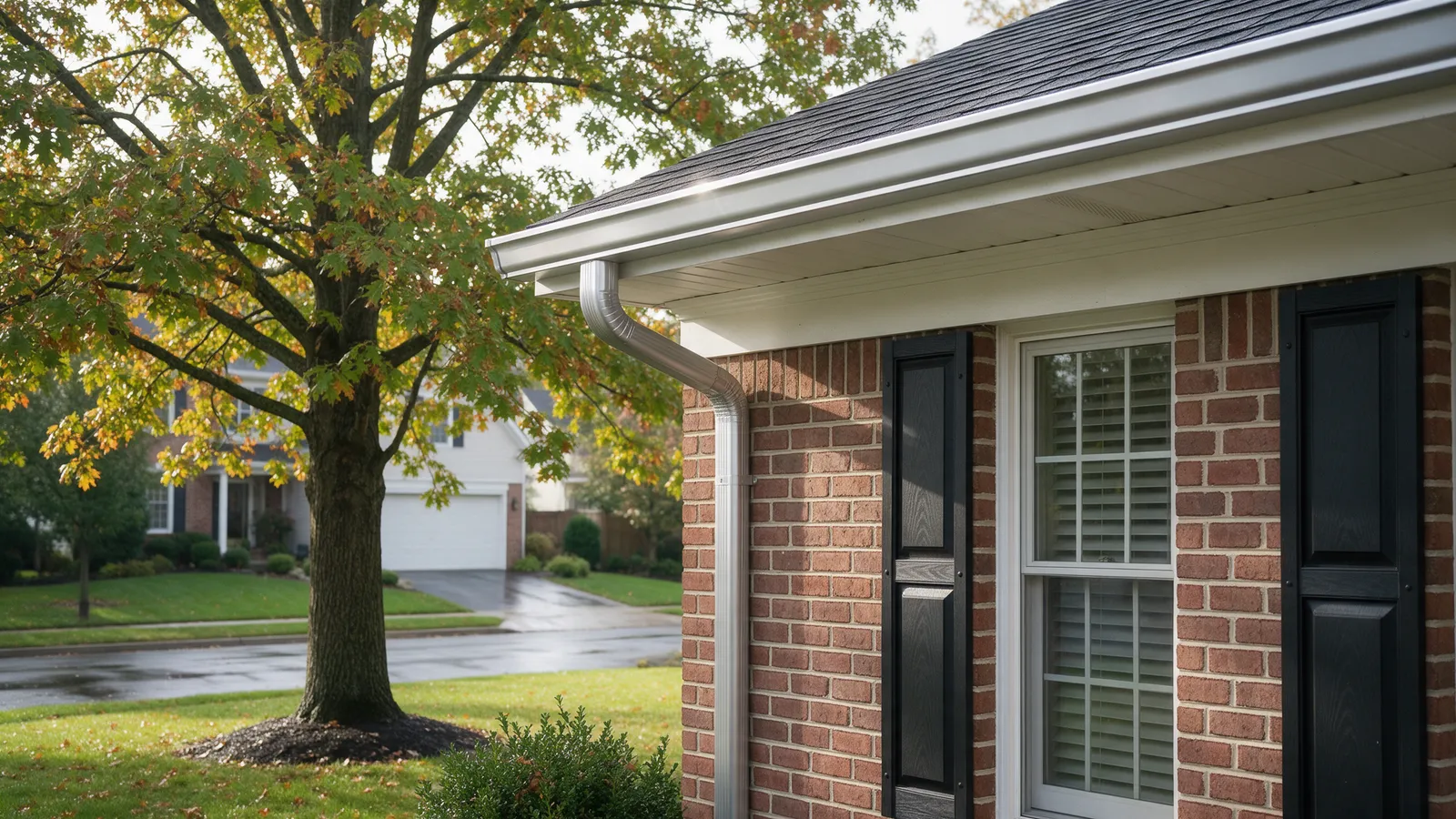
A bigger gutter only helps if the water can leave it. Typical pairings are 2x3 inch downspouts with 5-inch gutters and 3x4 inch downspouts with 6-inch gutters. Published rules of thumb put a 3x4 at roughly double the capacity of a 2x3, though the exact numbers vary by source, so ask your installer which ratings they use.
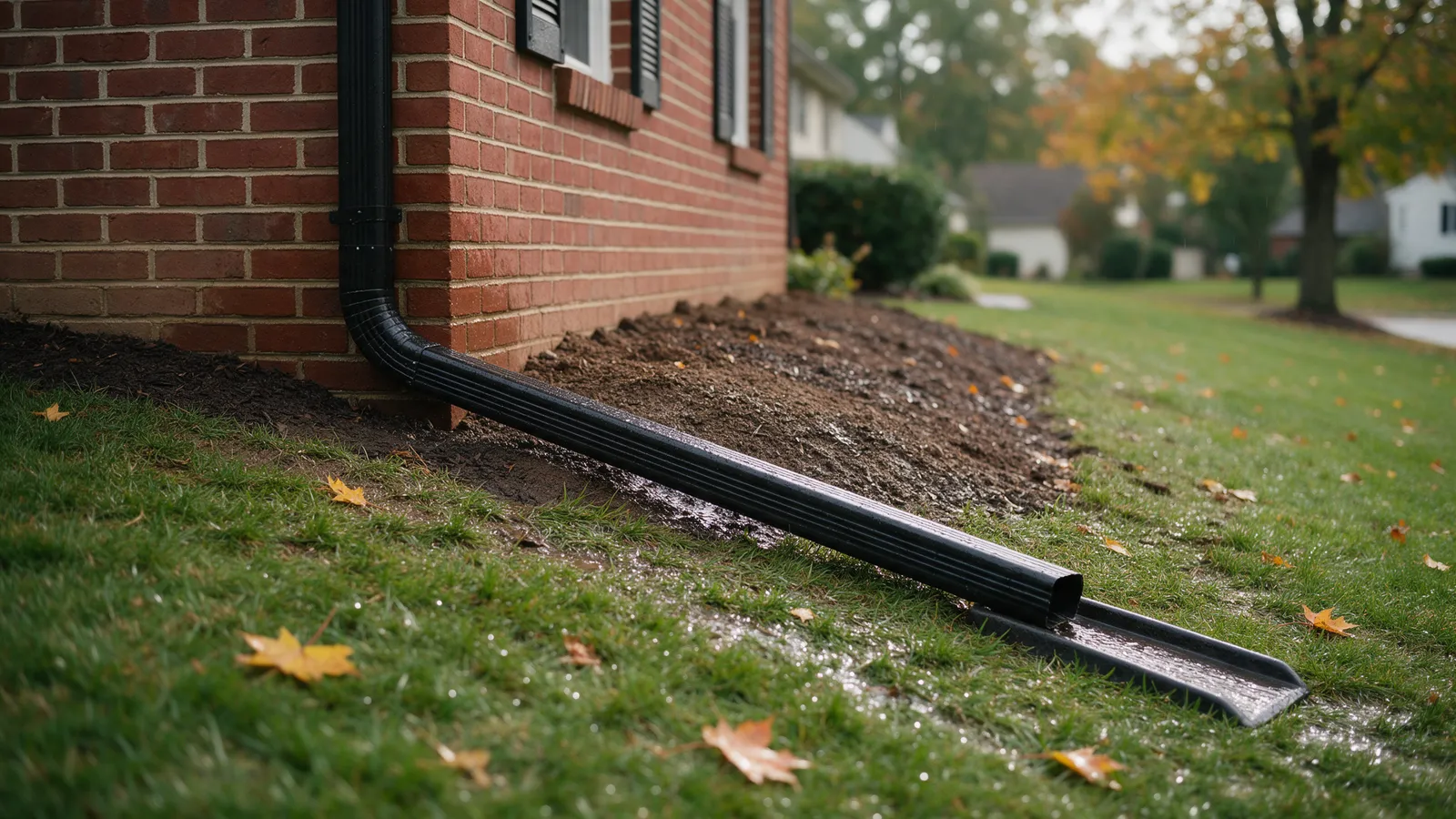
Also check the count. One downspout at the end of a 40-foot run is often asking too much. A common installer practice is to add an outlet to long runs. And once water is at the ground, move it away from the foundation. Our guide on downspout extensions and grading covers that step.
Step 7: Decide, and get quotes that compare cleanly
When you collect quotes, ask each installer for the same things in writing:
- Seamless or sectional, and what material and thickness
- Gutter size and downspout size, with the reason for each
- Number and location of downspouts
- How corners and end caps are sealed
- Hanger type and spacing
Hidden-hanger systems that fasten into the fascia at regular intervals are common, but ask about spacing rather than assuming. If you have heavy tree cover, read our comparison of gutter guards for oaks vs pines before you add them, since guards change how much water the system can take in.
Quick diagnosis: what your gutters are telling you
| What you see | Likely cause | First move |
|---|---|---|
| Drips at a connector | Failed sealant at a sectional joint | Clean and reseal, or consider seamless |
| Overflow at a valley only | Too much roof feeding one corner | Add a downspout; ask about 6-inch |
| Overflow everywhere, even when clean | Undersized gutter or downspouts | Get sizing from a pro |
| Water pooling mid-run | Pitch problem | Check hangers and slope |
| Streaks on siding below the gutter | Overflow or leaking seam | Hose test, then fix the source |
When to stop and call a professional
Gutter work looks easy and is a common reason for ladder falls. Hire an insured professional for:
- Anything above one story, or any work that needs you to reach out from a ladder
- Gutters near power lines or the service drop to the house
- Fascia or soffit that is soft, rotted or pulling away
- Roof edge repairs, flashing, or anything that means going onto the roof. Never walk on a roof yourself.
- A full replacement, which involves sizing, pitch and sealing that are easy to get wrong
If you are not sure whether a task is safe, it is not a DIY task.
Next steps
For whole-house gutters, our gutter services page explains what installation and repair involve. If overflow has stained siding or damaged the roof edge, see our siding and roofing pages, and read the fall gutter and roof check for a ground-level routine you can repeat each year. We serve homeowners across the areas we cover in DC, Maryland and Northern Virginia, and you can reach DMV Exterior at 202-798-7663.
Common questions
Are seamless gutters really better than sectional gutters?
Seamless gutters have fewer joints, and joints are where most gutters leak as sealant ages. That is the main advantage. They are not leak-proof, though: corners, end caps and downspout outlets are still sealed joints, so workmanship matters as much as the label.
Do I need 6-inch gutters in the DC area?
Not always. A common rule of thumb is that a roof section of roughly 600 to 800 square feet suits 5-inch gutters, while a much larger or steeper section benefits from 6-inch. Homes with big roof planes, valleys that dump into one gutter, or a history of overflow in summer thunderstorms are the usual candidates.
Can I put 6-inch gutters on my house without changing the downspouts?
You can, but you may not get the benefit. A bigger trough only helps if the outlet and downspout can carry the water away. Larger gutters are commonly paired with larger downspouts, such as 3x4 inch rather than 2x3 inch, so ask about both when you get a quote.
How can I tell if my gutters are too small?
Watch them during a hard rain. If water sheets over the front edge, or pours over at a valley or corner even though the gutter is clean, capacity or downspout count is the likely problem. Staining or splash marks on siding and mulch trenches below the eave tell the same story.
A note on safety
This guide is general information for homeowners, not a substitute for an on-site assessment. Anything that puts you on a roof, above a single story, or near power lines is work for an insured professional with fall protection.